Star Notes and Fancy Serial Numbers Explained
You do not need to spend a fortune to find collectible paper money. Some of the most interesting and valuable notes are hiding in plain sight, right in your wallet or cash register. Star notes and bills with unusual serial numbers have attracted a growing following of collectors who enjoy the treasure-hunt aspect of checking everyday currency for hidden gems. Understanding what to look for can turn routine transactions into opportunities to find something genuinely worth keeping.
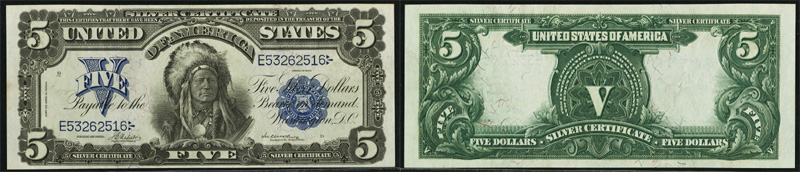
An 1899 $5 'Chief' Silver Certificate — serial number variations on notes like these can significantly affect value.
What Are Star Notes?
Star notes are replacement bills printed to substitute for notes that were damaged or found to be defective during the manufacturing process. Every piece of U.S. currency must have a unique serial number, so when a defective note is pulled from a print run, the Bureau of Engraving and Printing produces a replacement with the same serial number prefix but adds a small star symbol at the end. On modern Federal Reserve Notes, this star appears after the eight-digit serial number. Star notes are produced in much smaller quantities than regular notes, making them inherently scarcer. You can spot them instantly by looking for the star symbol next to the serial number on the front of the bill.
Why Star Notes Are Collectible
The value of a star note depends on how many were printed in that particular run. The Bureau of Engraving and Printing publishes production data, and collectors track print runs carefully. A star note from a run of 3.2 million is common and worth only a slight premium, but a star note from a run of 640,000 or fewer is considered scarce and can sell for several times face value even in circulated condition. Runs under 250,000 are rare and highly sought after. The denomination, series year, and Federal Reserve district all affect collectibility. Online databases allow you to look up any star note's print run in seconds, so checking is quick and easy.
Fancy Serial Numbers
Beyond star notes, collectors also prize bills with unusual serial number patterns. A solid serial number has all the same digit, such as 88888888, and is extremely rare and valuable. A ladder serial number counts up or down in sequence, like 12345678 or 87654321. A radar reads the same forwards and backwards (for example, 46800864), while a repeater has the first four digits matching the last four (such as 72137213). Low serial numbers, especially those under 00000100, carry strong premiums. Even binary notes, which contain only two different digits like 10010110, have a dedicated collector base. The rarer the pattern and the more visually striking the arrangement, the higher the premium a note will command.
Which Fancy Numbers Are Most Valuable?
Solid serial numbers are the kings of fancy numbers, with true solids (all eight digits the same) selling for hundreds or even thousands of dollars regardless of denomination. Seven-of-a-kind notes, where seven of eight digits match, are the next tier down and still bring strong premiums. Super radars, where the first and last three digits are the same with a different pair in the middle (such as 00090009 counted differently, or patterns like 99900999), are also highly prized. Perfect ladders (12345678 or 87654321) are extraordinarily rare on modern notes and can fetch significant money. For most other fancy patterns like standard radars, repeaters, and binary notes, the premium ranges from a few dollars to perhaps $20-50 for circulated notes, though uncirculated examples with popular patterns can do much better.
Checking Your Wallet
The beauty of collecting star notes and fancy serial numbers is that it costs nothing to start. Every time you receive cash, take a moment to glance at the serial numbers before you spend it. Look for the star symbol first, then scan for any obvious patterns in the digits. If you find a star note, look up the print run online. If you find an interesting serial number pattern, compare it against the known fancy number categories. Even circulated notes with desirable features are worth setting aside. Many collectors also check fresh currency straps from the bank, where sequential serial numbers make it easier to spot low numbers and other patterns. It is a hobby that pays for itself every time you pull something special out of ordinary pocket change.