Silver Certificates: What They Are and What They're Worth
Silver Certificates are among the most recognizable and widely collected types of U.S. paper currency. Issued from 1878 to 1964, these notes were originally redeemable for their face value in silver coin or, later, silver bullion. They are easy to identify by their distinctive blue Treasury seal and serial numbers, which set them apart from the green seals on standard Federal Reserve Notes. Although the government stopped redeeming them for silver in 1968, Silver Certificates remain legal tender at face value and are actively sought by collectors for their history and beauty.
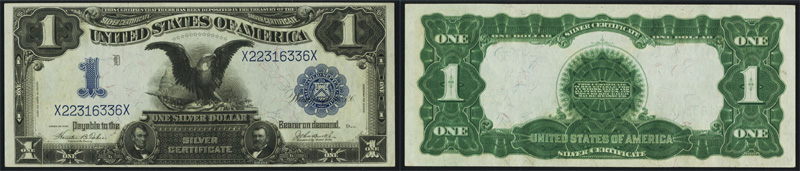
An 1899 $1 Black Eagle Silver Certificate — one of the most iconic U.S. notes.
A Brief History
Congress authorized Silver Certificates in 1878 as part of the Bland-Allison Act, which required the U.S. Treasury to purchase large quantities of silver and issue certificates backed by that metal held on deposit. The idea was straightforward: each certificate represented a specific amount of silver stored in Treasury vaults, and the holder could exchange the note for actual silver at any time. This system continued through various series dates and design changes until 1964, when the last Silver Certificates were printed. By 1968, rising silver prices made redemption impractical, and the program was officially ended.
Large Size vs. Small Size Silver Certificates
Silver Certificates were issued in both the large size format (1878-1923) and the small size format (1928-1957). The large size notes are particularly prized for their elaborate designs. The 1899 $1 "Black Eagle" note, featuring a bald eagle with outstretched wings across the top of the face, is one of the most iconic pieces of American paper money. Other notable large size issues include the 1896 "Educational Series," considered by many to be the most beautiful U.S. currency ever produced. Small size Silver Certificates, especially the common 1935 and 1957 series $1 notes, are abundant and affordable, making them an excellent entry point for new collectors.
Common vs. Rare Varieties
The vast majority of Silver Certificates you will encounter are small size $1 notes from the 1935 and 1957 series. In circulated condition, these are worth only a modest premium over face value. However, certain varieties can be quite valuable. The 1928C, 1928D, and 1928E $1 Silver Certificates are scarce and command strong prices. Among $5 notes, the 1934B and 1953B series are harder to find. The $10 denomination was only issued in the 1933, 1934, and 1953 series, with the 1933 $10 being a genuine rarity. Star notes, which have a small star symbol in the serial number indicating they are replacement notes, are worth more in every series.
Current Market Values
For common 1935 and 1957 series $1 Silver Certificates in circulated condition, expect to pay between $2 and $5 per note. Uncirculated examples of these same notes typically sell for $15 to $30, depending on the specific series letter. Scarcer small size varieties in nice condition can range from $50 to several hundred dollars. Large size Silver Certificates start around $75 to $150 for common dates in lower grades and can reach into the thousands for rare types or exceptional condition. The 1899 Black Eagle $1 in Very Fine condition typically trades for $150 to $250, while the 1896 Educational Series notes can bring $300 to $1,000 or more depending on denomination and grade. As with all collectible currency, condition is a major price driver, and original, problem-free notes always bring the strongest prices.