National Bank Notes: History and Value
National Bank Notes occupy a unique place in American currency history. Unlike most paper money, which was issued directly by the federal government, these notes were printed with the name, location, and charter number of individual banks in cities and towns across the country. Issued from 1863 to 1935, they represent a time when thousands of local institutions played a direct role in the nation's money supply. For collectors, National Bank Notes offer a compelling combination of local history, beautiful engraving, and genuine scarcity that few other types of currency can match.
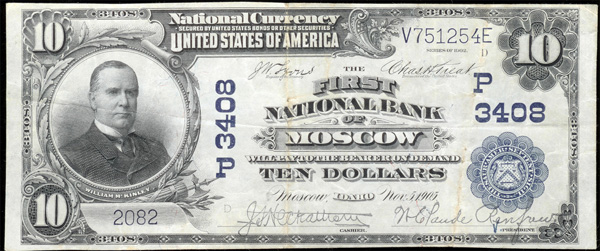
A 1902 $10 National Bank Note issued by a bank in Moscow, Idaho.
How the National Banking System Worked
The National Banking Act of 1863, passed during the Civil War to stabilize the currency and help finance the war effort, allowed qualifying banks to receive a federal charter and issue their own paper money. To do so, a bank had to deposit U.S. government bonds with the Treasury as collateral. The Treasury then authorized the bank to issue notes up to 90 percent of the value of those bonds. Each note was printed by the Bureau of Engraving and Printing with the individual bank's name, city, state, and charter number prominently displayed. Over the 72 years the system operated, more than 14,000 banks in every state and territory participated, producing an enormous variety of notes for collectors to pursue.
First Charter, Second Charter, and Third Charter Notes
National Bank Notes are categorized by charter period, which reflects changes in banking law over time. First Charter notes (1863-1882) are the earliest and rarest, featuring designs known as the "Original Series" and "Series of 1875." Second Charter notes (1882-1908) came in three distinct varieties: brown backs, date backs, and value backs, named for the designs on the reverse. Third Charter notes (1902-1929) include red seals, date backs, and the common plain back variety. When the note size shrank in 1929, all banks received the same standardized design in either Type 1 or Type 2 format. Each charter period has its devoted collectors, though first charter notes are the most expensive due to their age and rarity.
What Makes a National Bank Note Valuable
The primary value driver for National Bank Notes is the issuing bank's location. Notes from small towns are far rarer than those from large cities, simply because small-town banks issued fewer notes and fewer have survived. A note from a tiny bank in a remote Western territory can be worth thousands of dollars, while a note from a New York City bank in similar condition might sell for a fraction of that price. The state matters too: notes from territories like Alaska, Hawaii, Arizona, and Indian Territory are especially prized. Beyond location, the charter period, denomination, and condition all influence value. Notes in higher grades always bring stronger prices, and collectors also pay premiums for specific bank names, unusual serial numbers, or notes with historical connections to important events.
Collecting National Bank Notes
Many collectors focus on notes from their home state, county, or town, turning the hobby into a form of local history research. Others try to assemble one note from each of the 48 contiguous states, or collect by charter type and design variety. Small size nationals from 1929 are the most affordable entry point, with common large-city notes available for $50 to $150 in circulated grades. Large size nationals start higher, typically $200 and up for common types, and rare examples can reach five figures. When buying, always verify that the note is genuine and properly attributed. A good reference book listing known banks by state and charter number is an essential tool. The thrill of finding a note from your own hometown or an obscure bank that only issued a handful of notes is what keeps collectors coming back to this fascinating series.