How to Spot Counterfeit Bills
Whether you are a collector handling older notes or a business owner accepting cash, knowing how to detect counterfeit currency is an essential skill. The U.S. government has built increasingly sophisticated security features into modern bills to stay ahead of counterfeiters, and most fakes can be caught with a few simple checks that take only seconds. Familiarizing yourself with these features protects your money and gives you confidence when handling cash of any denomination.
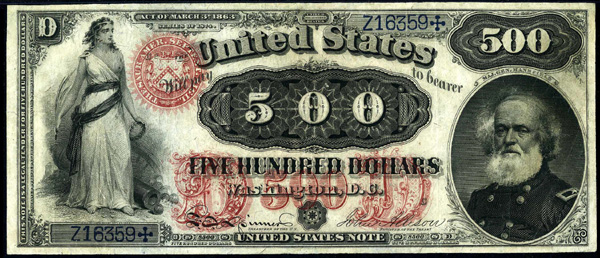
An 1874 $500 Legal Tender — high-denomination antique notes require careful authentication.
The Feel Test: Paper Quality
The first and often most reliable check is simply how the bill feels. Genuine U.S. currency is printed on a special blend of 75 percent cotton and 25 percent linen, which gives it a distinctive texture that ordinary paper cannot replicate. Real bills feel slightly rough and crisp, with a firmness that resists tearing. Counterfeit notes printed on standard wood-pulp paper feel smoother, flimsier, or sometimes waxy. If you handle genuine currency regularly, your fingers will quickly learn to detect the difference. Additionally, look closely at the paper itself: authentic bills have tiny red and blue fibers embedded randomly throughout. These are woven into the paper, not printed on the surface. If you see colored specks that appear to sit on top of the paper or can be scraped off, the note is likely counterfeit.
Watermarks and Security Threads
Hold any modern bill ($5 and above) up to a light source and you should see two important features. First, a watermark portrait will be visible from both sides of the note, embedded in the paper to the right of the main printed portrait. On a $20 bill, for example, you will see a faint image of Andrew Jackson. The watermark should match the portrait on the bill; if it shows a different face, someone may have bleached a lower denomination and reprinted it as a higher one. Second, you will see a thin security thread running vertically through the note. Each denomination has its thread in a different position, and the thread is imprinted with tiny text indicating the denomination. Under ultraviolet light, these threads glow different colors depending on the denomination: $5 glows blue, $10 glows orange, $20 glows green, $50 glows yellow, and $100 glows pink.
Color-Shifting Ink and Microprinting
Bills of $10 and higher printed since 1996 feature color-shifting ink on the numeral in the lower-right corner of the face. Tilt the bill back and forth and the number should shift from copper to green (or gold to green on the newer $100). This optically variable ink is extremely difficult and expensive to replicate, making it one of the most reliable quick checks available. Microprinting is another strong indicator of authenticity. Using a magnifying glass, you can find tiny text printed in various locations on the bill that is too small for most copiers and printers to reproduce clearly. On a $20 bill, for instance, look for "THE UNITED STATES OF AMERICA" repeated along the border of the portrait oval and "USA20" along the blue eagle banner. Blurry or unreadable microprinting is a clear sign of a counterfeit.
The Newer $100 Bill: Additional Features
The redesigned $100 bill introduced in 2013 includes several additional security features worth knowing, since hundreds are the most commonly counterfeited denomination. A blue 3-D security ribbon is woven into the paper, not printed on it. When you tilt the bill, small bells on the ribbon change to the number 100 as you move it. The copper-colored inkwell on the face contains a bell that appears and disappears as you tilt the note. These features are nearly impossible to counterfeit with consumer-grade equipment. The $100 also has a large gold numeral 100 on the back that makes it easy to verify the denomination at a glance.
What to Do If You Find a Counterfeit
If you suspect you have received a counterfeit bill, do not attempt to return it to the person who gave it to you or pass it along to someone else, as knowingly using counterfeit currency is a federal crime. Instead, handle the note as little as possible to preserve any fingerprints, and place it in a protective envelope or plastic bag. Write down a description of the person who passed it to you, including any details about the transaction. Then contact your local police department or the nearest U.S. Secret Service field office, which is the federal agency responsible for investigating counterfeiting. If you are a business owner, you may also want to invest in a basic UV light or counterfeit detection pen for your register, though these tools are supplements to, not replacements for, the visual and tactile checks described above. A detection pen tests the paper's starch content and can miss sophisticated counterfeits printed on washed genuine paper, so always rely on the security features built into the bill itself.