Gold Coins: What Makes Them Valuable
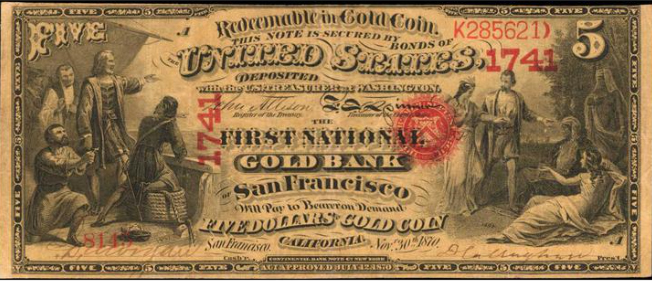
A rare $5 National Gold Bank Note issued by a San Francisco bank — one of the few U.S. notes redeemable in gold coin.
U.S. Gold Coin Denominations
The United States produced gold coins for regular circulation from 1795 until 1933, spanning a remarkable range of denominations. The smallest was the gold dollar, struck from 1849 to 1889. The quarter eagle ($2.50) was produced from 1796 to 1929. Half eagles ($5) were among the first coins struck by the U.S. Mint, beginning in 1795 and continuing to 1929. Eagles ($10) ran on a similar timeline. The largest denomination, the double eagle ($20), was introduced in 1849 following the California Gold Rush and continued through 1933. Each denomination went through multiple design types over its production history, giving collectors a wide field to explore.
The Saint-Gaudens Double Eagle
Widely considered the most beautiful U.S. coin ever made, the Saint-Gaudens double eagle was designed by sculptor Augustus Saint-Gaudens at the personal request of President Theodore Roosevelt. First struck in 1907, the coin features a full-length figure of Liberty striding forward with a torch and olive branch on the obverse, and a majestic eagle in flight on the reverse. The earliest 1907 issues came in high relief and ultra-high relief versions that are extremely rare and valuable. Regular production continued through 1933, though the 1933 issue was largely melted and is now one of the most famous rarities in all of numismatics. Common-date Saints in average condition trade close to their gold melt value, but key dates and high-grade examples can bring substantial premiums.
Liberty Head Series
Before the Saint-Gaudens designs, the Liberty Head motif dominated U.S. gold coinage. The Coronet Head (or Liberty Head) design by Christian Gobrecht appeared on half eagles from 1839 to 1908 and eagles from 1838 to 1907. The double eagle featured a similar Liberty Head design by James B. Longacre from 1849 through 1907. These coins were produced at multiple mints including Philadelphia, San Francisco, Denver, Carson City, Charlotte, Dahlonega, and New Orleans. Southern mint issues from Charlotte (C) and Dahlonega (D) are particularly scarce and valuable, as those mints had low production numbers and many of their coins were melted over the years.
Melt Value vs. Numismatic Premium
Every U.S. gold coin has a baseline value determined by its gold content and the current spot price of gold. A double eagle contains 0.9675 troy ounces of gold, an eagle has 0.4838 ounces, a half eagle has 0.2419 ounces, a quarter eagle has 0.1209 ounces, and a gold dollar has 0.04837 ounces. The numismatic premium is the amount a coin's market value exceeds its melt value, and it depends on rarity, condition, and demand. Common-date gold coins in circulated condition often trade at modest premiums over melt, making them an accessible entry point for collectors. Rare dates, high grades, and coins with original luster and eye appeal can command premiums many times their gold content.
Modern Gold Coins: The American Gold Eagle
In 1986, the United States Mint resumed gold coin production with the American Gold Eagle program. Available in one-ounce, half-ounce, quarter-ounce, and tenth-ounce sizes, these coins use a design inspired by the classic Saint-Gaudens double eagle on the obverse. American Gold Eagles are made from 22-karat gold (91.67% gold, alloyed with silver and copper for durability) and are legal tender. While most modern Gold Eagles trade near their bullion value with a small dealer premium, certain dates and low-mintage issues have developed collector followings. The American Gold Buffalo, introduced in 2006, uses 24-karat (.9999 fine) gold and offers an alternative for those who prefer pure gold content. Both programs provide a modern, convenient way to own gold coins.