Error Coins: What to Look For
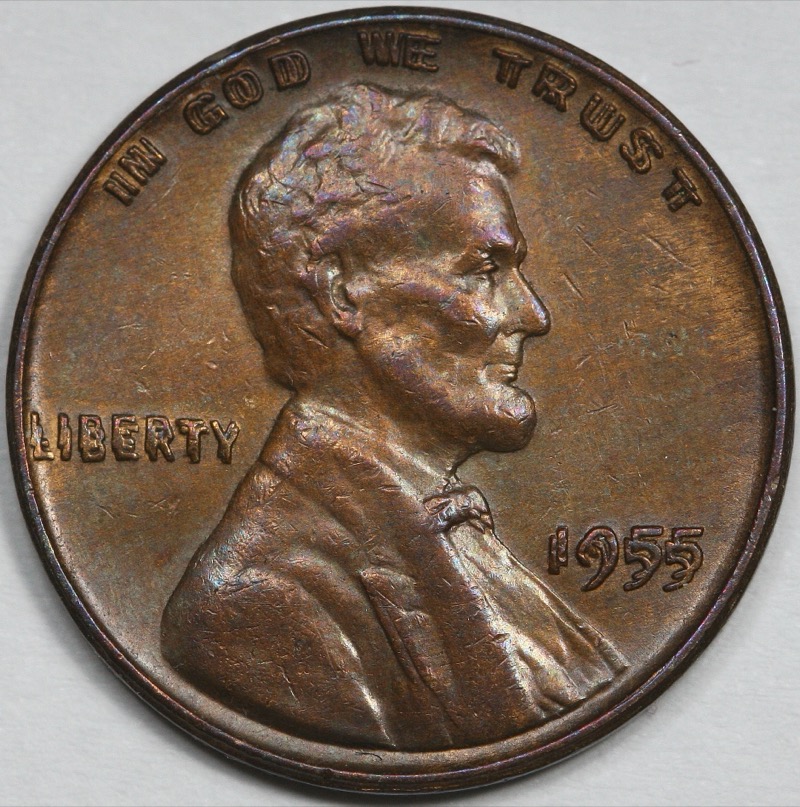
The famous 1955 Doubled Die Lincoln Cent — dramatic doubling visible on the date and lettering without magnification.
Doubled Die Errors
Doubled die errors are among the most sought-after mint mistakes in numismatics. They occur during the die-making process when a working hub impresses its design onto a working die more than once with a slight misalignment between impressions. The result is a die that produces coins with visibly doubled lettering, dates, or design elements. The most famous example is the 1955 doubled die Lincoln cent, which shows dramatic doubling on the obverse date and lettering that is easily visible without magnification. Other notable doubled dies include the 1969-S and 1972 Lincoln cents, the 1916 Buffalo nickel, and the 1917 Type 1 Standing Liberty quarter. When examining coins for doubling, focus on the lettering and date, and use a magnifying loupe of at least 5x power.
Off-Center Strikes and Wrong Planchet Errors
Off-center strikes happen when a coin blank is not properly seated in the collar die before the press strikes it, resulting in a coin with the design shifted to one side and a blank crescent on the other. The value of an off-center error depends on how far off-center the strike is and whether the date is still visible. A coin struck 50% off-center with a readable date is generally more valuable than one struck only 5% off or one struck so far off that the date is missing. Wrong planchet errors, also called wrong metal errors, occur when a blank intended for one denomination accidentally feeds into a press set up for a different coin. A famous example is a dime struck on a copper penny planchet. These errors are rare and can be quite valuable because they require multiple quality-control failures to escape the Mint.
Clipped Planchets and Die Cracks
Clipped planchet errors occur during the blanking process, when the punch that cuts circular blanks from a metal strip overlaps with a previously punched hole. The result is a coin with a curved bite taken out of its edge. Straight clips can also occur if the blank is cut too close to the edge of the metal strip. The size of the clip affects value, with larger clips generally being more desirable. Die cracks and die breaks are another common error type. As dies are used repeatedly under tremendous pressure, they develop stress fractures. These cracks transfer raised lines onto the finished coin. A major die break can produce a "cud," where a chunk of the die breaks away entirely, leaving a raised, featureless blob on the coin's surface. Cuds on key areas of the design are particularly collectible.
How Errors Happen at the Mint
The U.S. Mint produces billions of coins each year using high-speed presses that stamp out hundreds of coins per minute. At that volume and speed, errors are inevitable despite extensive quality controls. Blank planchets go through multiple stages: the metal is rolled to the correct thickness, blanks are punched out, those blanks are annealed (heated and cooled) to soften them, then upset (the rim is raised), and finally struck between a pair of dies inside a collar. An error can occur at any of these stages. Feeding problems cause off-center strikes. Die manufacturing issues create doubled dies. Mixed-up planchet bins lead to wrong-metal errors. While the Mint's quality-control systems catch most of these mistakes, some inevitably escape into circulation, where sharp-eyed collectors can find them.
Checking Your Change and Authentication
Error coin hunting can start as simply as paying closer attention to your pocket change. Look for any coins that seem unusual: an off-center design, visible doubling on lettering, a coin that seems the wrong color or weight for its denomination, or an irregular edge. Coin roll hunting, where you buy rolls of coins from a bank and search through them, is a popular way to find errors and varieties. If you find what you believe is a significant error, resist the urge to clean it, as that will reduce its value. Instead, store it safely in a non-PVC holder and seek professional authentication. Third-party grading services like PCGS and NGC authenticate and encapsulate error coins, which adds both credibility and value. A certified error coin will almost always sell for more than a raw, uncertified one.